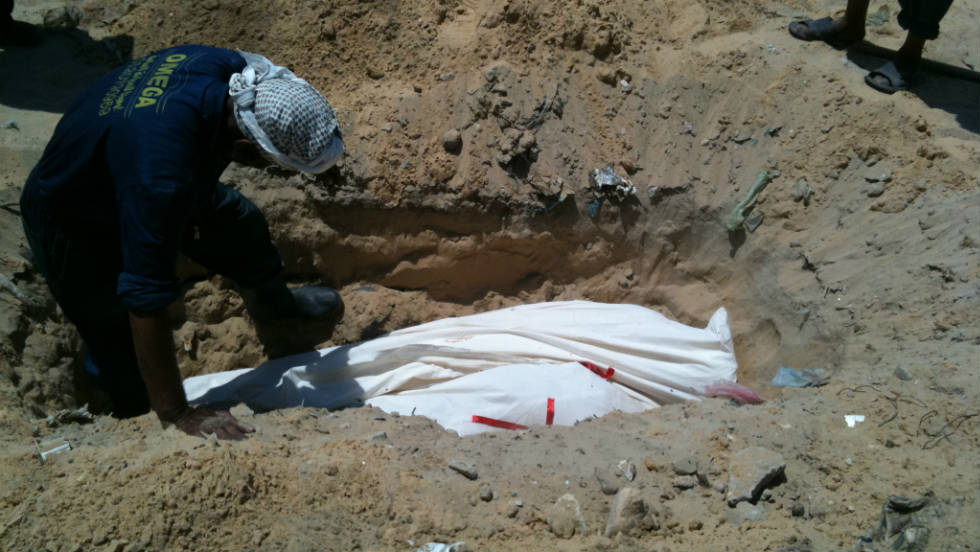
Tribesmen exploit refugees' battle 02:29
Story highlights
- Every year, thousands attempt dangerous journey from African countries to Israel
- Few make it; many bodies of unsuccessful refugees lie in morgue in El Arish, Egypt
- One man combs desert searching for corpses, ensuring they get dignified burial
- Many refugees are enslaved and tortured; women are raped by Bedouin tribes of Sinai
"I wanted to build a good future for my family, but I failed," a weak Issam Abdallah Mohammed said in a videotaped statement.
The
refugee from the Darfur region of Sudan was trying to illegally cross
the border from Egypt to Israel when he was discovered and shot by
Egyptian border guards.
Less than an hour after taping the statement, Issam was dead, succumbing to the wounds inflicted by the gunshots.
Every
year, thousands of refugees, mostly from Eritrea, Ethiopia and Sudan,
attempt the dangerous journey from their war-torn countries to Israel in
search of economic prosperity and stability.
Very
few make it, and the results of the failed migration can be seen in the
morgue of the central hospital in the Egyptian port town of El Arish.
Ending organ trafficking 02:29
When
a CNN crew visited there recently, all the refrigeration units were
broken, leaving a biting stench of decaying corpses in the air, which
staff members attempted in vain to cover up with chlorine-based cleaner
and incense.
On any given day, the morgue will be packed with the bodies of African refugees who died trying to make it to Israel.
Hamdy
Al-Azazy spends a lot of time here as head of the New Generation
Foundation for Human Rights, which tries to help African refugees in
Egypt.
Every week, Al-Azazy combs the desert, searching for corpses, ensuring that they get a dignified burial.
He
has spent the past seven years helping the refugees. Many are enslaved
and tortured and the women raped by the Bedouin tribes of the Sinai if
they are unable to come up with large sums of money the Bedouin try to
extort from them and their families, to smuggle the refugees across the
border into Israel. As a result, many remain imprisoned in camps on the
Sinai Peninsula.
"They are chained and
kept in camps in the open with no bathrooms and little water and food
and treated worse than animals," Al-Azazy said.
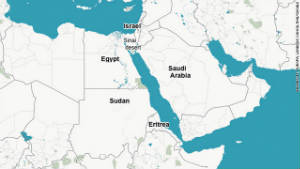
Map: Refugees head to Israel
"Some
of them are taken to Libya, but 80% of them are smuggled to Israel.
Those who escape are shot by the Bedouins, and others who make it to the
border are sometimes shot by the Egyptian authorities and transferred
to hospitals before spending a year in different prisons in Sinai and
deported back home."
The CNN crew found
two victims in the hospital in El Arish, handcuffed to their beds and
awaiting their transfer to an Egyptian detention center and eventual
deportation.
One of them, Mahary Taklay
Abraham of Eritrea, says he hit his head falling off a rock while
trying to cross the border and was caught by Egyptian border guards. But
before making it to the border, Mahary says, he spent about two months
with the Bedouins.
"They beat and tortured me continuously and demanded money from my family," Mahary said.
Al-Azazy
says this is a common scheme. The refugees will pay Bedouin tribes in
the border area between Sudan and Egypt around $2,000 to be smuggled
out. The smugglers then sell the refugees to the Sinai Bedouin, who
blackmail the refugees and their families back home.
Ibrahim Yehia of Eritrea says he fell prey to the Bedouin.
"When
we arrived to Sinai, the Bedouins tied me up with metal chains in the
desert. They tortured us. Many of us died," he said, displaying his
wounds, including scars that he says came from electroshock torture.
"They
wanted me to pay $12,000 and forced us to call our families to transfer
the money. My family sold all their lands and even their donkey to
collect the money. They transferred $6,000 to the Bedouins."
After his family paid, Yehia says, the Bedouin finally let him go.
"I
spent three months tied up in the camp close to the Israeli border.
After I paid, the Bedouins drove me to the border crossing and set me
free. I was then shot by plainclothes men close to the wired fence at
the Israeli-Egyptian border. The military took me to the hospital."
Some
of the refugees are forced into slave labor, often working marijuana
fields that flourish all over Northern Sinai, Hamdy Al-Azazy says.
Refugees who made it across the border into Israel have told harrowing
accounts of rape, torture and slave labor.
Women
are especially vulnerable. CNN spoke to one victim who made it to
Israel and spoke on condition of anonymity. She said she was raped
almost daily on a journey that took several months to get to Tel Aviv.
"Every night, they took me separately, and they did whatever they wanted to my body," the Eritrean said.
Al-Azazy
hears stories like this all the time. "The women and men are kept in
open areas. These Bedouins don't have any morals or conscience. One girl
told me that three Bedouins had raped 14 girls in one night," he said.
When
CNN confronted a leader of the Sawarka Bedouin tribe, one of the
largest in Sinai, the chief said he was aware that people trafficking is
going on in Sinai and that in some cases African refugees are held in
bonded labor, tortured and women raped.
The
Sawarka chief, who did not want to be named for this report, said that
only rogue elements of the tribe are involved in people trafficking.
This
same chief took CNN to a secret location and allowed them to speak to
five African refugees who were hoping to make it to Israel, in an
apparent bid to show us that the refugees were being well treated.
But
interviews with refugees who have escaped the camps or been released
suggest that mistreatment and even murder are commonplace in the Bedouin
camps.
One Bedouin leader willing to go on record is called Salem, a powerful chief of the Tarabine tribe.
He
acknowledges that people trafficking exists among members of the
Tarabine and Sawarka tribes, but he says that it is only a fraction of
the members who are involved in the trade and that they are ruthless.
"You
can't label the whole tribe or implicate it in this trade. The Bedouins
in Sinai are over 150,000. Those working in this business will not
exceed more than 50 people."
During an interview by the Red Sea, Salem said he loathes those involved in people trafficking, torture, rape and murder.
But he acknowledges that Bedouin leaders are doing little to stop the illicit business out of fear of stoking tribal infighting.
"These
guys are evil. They do not care where to get money. They deal with a
middleman in Africa to get those men. These Africans spend months here,
sometimes up to six months in Sinai, before crossing -- if they cross."
Egypt's government and armed forces seem powerless to stop the Bedouin smugglers.
Police
units have been forced out of most areas in North Sinai after the
revolution that swept longtime leader Hosni Mubarak from power. A
military operation aimed at combating Islamist extremists in the area
has done little to stop people trafficking in this lawless region that
runs mostly on criminal activity, such as smuggling of goods into Gaza
and drug trafficking.
Meanwhile, more
bodies turn up in the Sinai desert. In a matter of weeks, several more
were buried by Hamdy Al-Azazy close to the grave of Issam Abdallah
Mohammed, the refugee from Darfur who recorded a video shortly before
his death.
While the bodies of those
who can be identified are buried in cemeteries in El Arish, the many
corpses that remain nameless -- because they carry no identity cards or
have decomposed beyond recognition -- are laid to rest outside the
cemetery walls in an anonymous mass grave under heaps of trash from an
adjacent slum.


No comments:
Post a Comment